Vastu Consultant
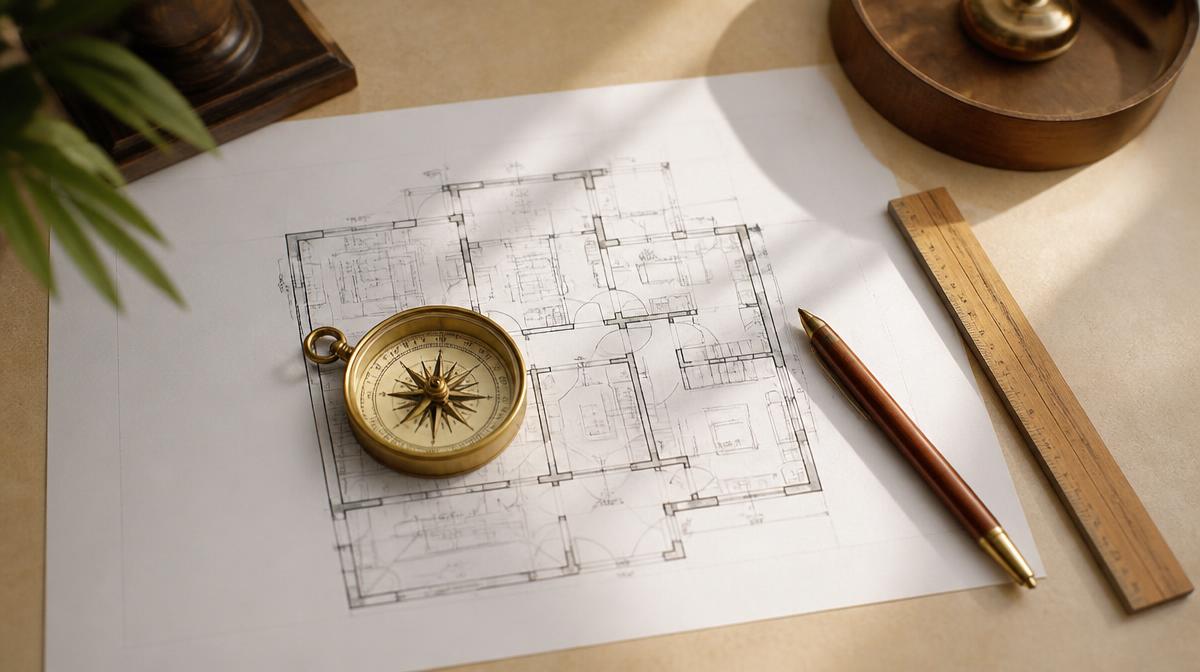
Available online worldwide by video call, and in person at our Chhatrapati Sambhajinagar (Aurangabad) and Pune offices.
A Vastu consultant assesses how a property is laid out against classical Vastu principles, identifies what is causing difficulty, and recommends corrections. The word is written both as vastu and as vaastu and means the same thing. Divyam Vaastu has practised since 1992, with a head office in Chhatrapati Sambhajinagar (Aurangabad) and a branch office in Pune, consulting on site across India and online worldwide.
What a Vastu consultant actually does
The work has three parts. The first is assessment: reading the layout, the orientation of the building on its plot, and the directional placement of each function within it against classical Vastu principles. That means taking accurate compass directions rather than assuming them, and understanding how the space is actually used rather than how the drawing labels it. The second is identification: naming the specific issues in your property, in the sectors where they occur, instead of offering general observations that could apply to any building. The third is correction: practical remedies that work within the existing structure wherever possible, so that structural change is the last option considered rather than the first one proposed.
A consultant should give you the reasoning, not just the instruction. If you are told to move a bed, you should also be told which direction it is being moved to and why that direction matters for that room. That is what separates advice you can act on from a list you have to take on trust. It also lets you carry the work out in stages, since you understand which corrections are addressing the larger issues and which are refinements that can wait.
What a consultation does not do is guarantee an outcome. Vastu is applied to a space, and a space is one of many factors in how life in it goes. Anyone offering certainty is overselling.
When people consult a Vastu consultant
The most common points are these. Before buying a property, when the question is whether this one is worth committing to. When choosing between two or three options, where the layouts look similar and the orientations are not. Before construction or redevelopment, when the plan can still be changed on paper. When moving into a new space, whether it is a home, an office or a shop. When a business is not moving as it should and the reason is not obvious from the numbers. And during a difficult period in a household where the cause is unclear and the space itself has not been examined.
The earlier in that sequence you consult, the cheaper the correction. A pre-purchase assessment costs a fraction of correcting a completed building, because at that stage the remedy available to you is simply choosing a different property or a different unit. Once construction is finished, the same issue may need reworking that costs many times more, and some plot-level issues cannot be fully corrected at all.
That is also why we would rather look at a floor plan with you before you sign than be called in a year later. It is a shorter piece of work and it usually saves more.
What a consultant looks at
The entrance comes first: which direction it faces and where it sits along that side of the building, since both matter and they are not the same question. Then the kitchen and the placement of the fire element within it, the orientation of the bedrooms and the sleeping direction within each, and the water sources, including the overhead tank, any underground tank and the borewell position on an independent plot. Toilet placement is assessed relative to the kitchen and to any pooja space rather than in isolation. Heavy storage and structural mass are considered next, because where the weight of a building sits changes how the space reads. For independent properties, plot shape, the boundary treatment, the open space on each side and the road position all come into the assessment.
These factors interact. An entrance in one sector may be unremarkable in one layout and worth correcting in another, depending on what sits opposite it and where the kitchen and water fall. A checklist read online treats each item as a separate rule with a fixed verdict, which is why it so often produces alarm about something that does not matter in your particular case, and silence about something that does.
Assessment of a specific property is what turns those principles into a usable answer. That is the part a general article cannot do for you.
Property types we consult on
Flats and apartments, where the built form is fixed and the leverage sits in unit selection before purchase and in placement afterwards. Independent houses and bungalows, where plot shape, boundary, entrance approach and water position all come back into play. Row houses, which sit between the two, with a fixed built form but some plot-level factors still live.
On the commercial side, offices and workspaces, shops and retail units, showrooms and clinics, where entrance orientation and seating direction for the people making decisions carry most of the weight. Industrial units and factories, where machinery placement, furnace position, storage of raw material and finished goods, effluent handling and the administrative block are all assessed on site.
Plots and land before construction are the most useful assessment of all, because at that stage nothing has been built and everything can still be positioned correctly.
On site or online
On site is necessary for plots and land, for new construction, for industrial sites and for anything involving dowsing, because those need physical presence. Directions have to be taken on the land itself, levels and slope have to be seen, and dowsing cannot be conducted from a drawing at all.
Online works well for flats, apartments and offices, where the built form is fixed and an accurate floor plan with reliable compass directions gives us what we need. It is how we serve clients in the UAE, USA, UK, Australia, Singapore, Netherlands and Tanzania, and how we serve clients in Indian cities where a visit is not practical.
Taking the compass directions accurately is the part that matters. Use your phone compass, hold it flat and level rather than tilted, keep it away from metal, wiring, appliances and electronics, and stand at the centre of the main room rather than in a doorway or against a wall. Take the reading two or three times and confirm you get the same figure before noting it down. Send that along with the floor plan and photographs of each room and of the entrance approach.
Online consultation costs less than an on-site visit, because there is no travel involved.
How to choose a Vastu consultant
Four things are worth asking before you book. How long have they practised, and what property types do they usually handle, since a consultant who works mostly on flats and one who works mostly on factories are not doing the same job. What does the fee cover, and is it fixed before the work begins rather than settled afterwards. Do the remedies require buying products from them, which is the question that most often reveals what the consultation is really for. And will they explain the reasoning behind each recommendation, or only issue the instruction.
The warning signs are just as useful. Fear-based framing, where a problem is described in alarming terms and the only escape offered is an expensive remedy. Pressure to buy gemstones, yantras or energy products during the consultation itself. Refusal to explain the reasoning, usually deflected as something you would not understand. Demolition proposed as a first resort rather than a last one. And any guarantee of a specific outcome, which no honest practitioner can give.
If a consultation leaves you understanding your own property better than when you started, it was worth taking. If it leaves you only with a shopping list, it was not.
Consulting us
Divyam Vaastu has practised Vastu Shastra since 1992. The head office is in Chhatrapati Sambhajinagar (Aurangabad) and the branch office is in Pune, with on-site consultation elsewhere in India by arrangement and online consultation worldwide.
Visits are by prior appointment, and in-person availability depends on us being in town, since the practice runs from both offices and site visits take us out of the city regularly. Tell us the property type, the location and what you are trying to decide, and we will tell you honestly whether a site visit is needed or whether a plan review answers the question.
Written reports are available and are confirmed before we start, so you know what you are receiving. Fees depend on the property type, the size of the property, whether the consultation is on site or remote, and the travel involved, which is why they are quoted per property rather than published as a fixed rate.
Avinash Maggirwar
Vastu & Astrology Consultant
- Vastu Shastra
- Vedic Astrology
- Dowsing
Abhijit Maggirwar
Vastu & Astrology Consultant
- Vastu Shastra
- Vedic Astrology
- Kundali Matching
Our offices
Frequently Asked Questions
What does a Vastu consultant do?
A Vastu consultant assesses how a property is laid out and oriented against classical Vastu principles, identifies the specific issues present in that property rather than general ones, and recommends corrections that work within the existing structure wherever possible. That covers the entrance, the kitchen, the bedrooms and sleeping directions, water sources, toilet placement, heavy storage, and plot shape and boundary for independent properties. A good consultation also explains the reasoning, so you understand why each recommendation is made.
How much does a Vastu consultant cost?
The fee depends on the property type, the size of the property, whether the consultation is on site or remote, and the travel involved in reaching it. A floor plan review for a flat is a different piece of work from a full site visit to a bungalow, a plot or an industrial unit, so we confirm the fee once we understand the property rather than publishing a fixed rate. Our fees page sets out what drives the cost.
Can a Vastu consultation be done online?
Yes for most property types, including flats, apartments and offices. You need an accurate floor plan, compass directions taken with a phone compass held level and away from metal and electronics from the centre of the main room, and photographs of each room and of the entrance approach. Plots, new construction, industrial sites and dowsing need physical presence, so those are always on site.
Do I need to demolish anything for Vastu corrections?
In most cases no. A large share of corrections are made without any construction: changing the sleeping direction, reorienting a desk or workstation, moving heavy storage toward the south and west, adjusting mirror placement, relocating the pooja space, changing how a room is used, and colour and material choices in specific sectors. Where a structural issue genuinely cannot be moved, the remedy is chosen to work around it. Demolition should be the last option, not the opening suggestion.
How do I choose a good Vastu consultant?
Ask four things before booking: how long they have practised and which property types they usually handle, what the fee covers and whether it is fixed in advance, whether the remedies require buying products from them, and whether they will explain the reasoning behind each recommendation. Walk away from fear-based framing where the only escape is an expensive remedy, pressure to buy gemstones or yantras during the session, refusal to explain reasoning, demolition proposed first rather than last, and any guarantee of specific outcomes.
Contact
Phone: +91 98220 88033