Vedic vs Western Astrology: Sidereal and Tropical Explained
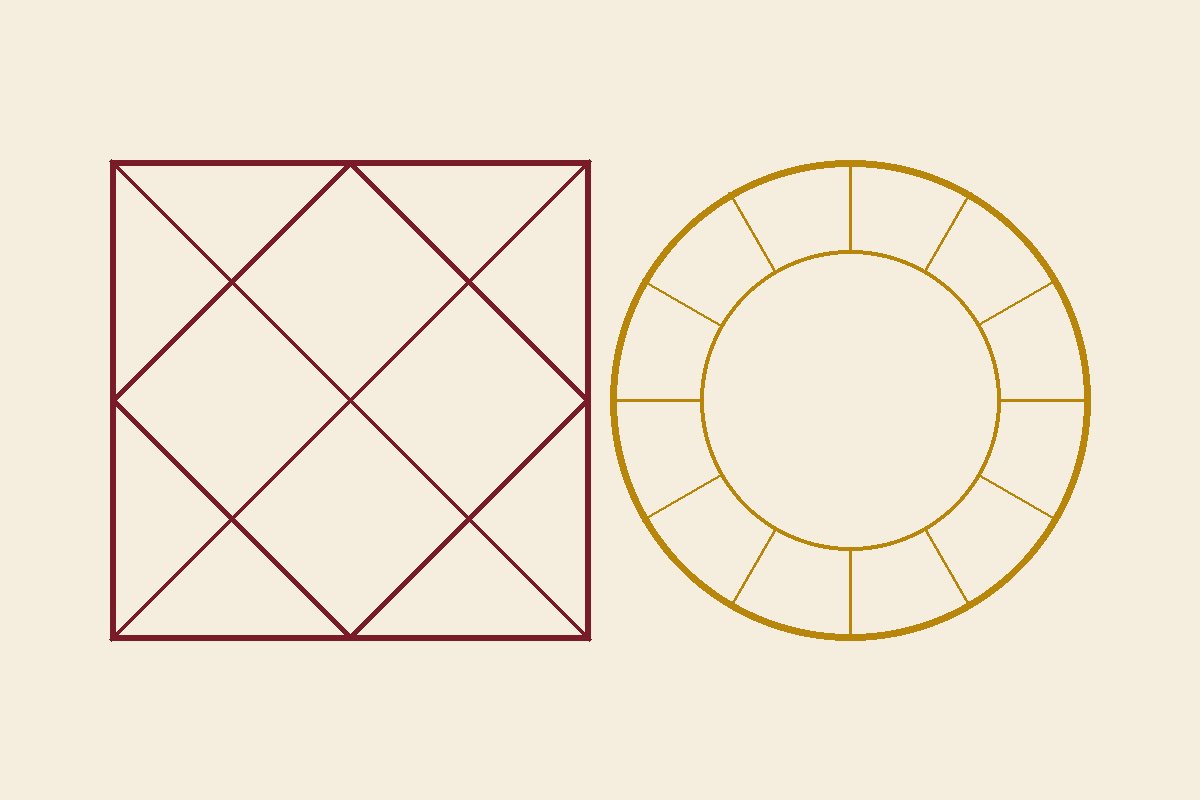
Vedic astrology uses the sidereal zodiac, fixed to the stars, and reads the Moon, nakshatras and dasha periods closely. Western astrology mostly uses the tropical zodiac, fixed to the seasons, and centres the Sun sign. The zodiacs are about 24 degrees apart, so most people's Vedic sign is one earlier than their Western sign.
Many people meet Vedic astrology after years of reading a Western horoscope, and the first surprise is usually that their sign has changed. Someone who has always been a Leo finds they are a Cancer in their kundali. Nothing has gone wrong. The two systems measure the zodiac from different starting points, and that single difference leads to several others.
This guide explains those differences for a reader who knows Western astrology and is new to Vedic astrology, also called Jyotish (Vedic astrology). We practise Vedic astrology, so we write about it from the inside, and we describe Western astrology in terms its own practitioners would recognise. Neither system is presented here as the correct one.
The short answer
Vedic astrology uses the sidereal zodiac, fixed to the stars, and reads the Moon, the nakshatras and dasha periods closely. Western astrology mostly uses the tropical zodiac, fixed to the seasons, and centres the Sun sign and psychological interpretation. Because the two zodiacs are currently about 24 degrees apart, most people's signs shift back by one.
Sidereal vs tropical: the difference that moves your sign
Both systems divide the sky into the same twelve signs of 30 degrees each. What differs is where the count begins.
- The tropical zodiac, used by most Western astrologers, starts Aries at the spring equinox. It is tied to the seasons, so it stays aligned with the Earth's year.
- The sidereal zodiac, used in Vedic astrology, starts Aries against a fixed point among the stars. It is tied to the constellations as they actually appear.
The Earth's axis wobbles slowly, an effect called the precession of the equinoxes, so the equinox point drifts backwards against the stars by roughly one degree every 72 years. The two zodiacs were close together many centuries ago and have moved apart since. The gap between them is called the ayanamsa. We use the Lahiri ayanamsa, the standard adopted in India, which places the gap at about 24 degrees today.
A 24 degree shift is most of a sign, so any planet in the first 24 degrees of a tropical sign falls in the previous sign in a sidereal chart. That is why most people's Vedic Sun sign is one earlier than their Western one, and why a minority, born late in a sign, keep the same sign in both.
Sun sign or Moon sign
Western astrology as most people meet it is built around the Sun sign, the sign the Sun occupied at birth. It is the sign in a newspaper horoscope.
Vedic astrology gives the Moon far more weight. Your rashi, the sign the Moon occupied at birth, is the sign most often referred to in India, and the ascendant, the sign rising on the eastern horizon, sets the framework of the whole chart. The Sun still matters, but it is one factor among several rather than the headline.
Nakshatras: the 27 lunar mansions
Vedic astrology divides the zodiac a second way, into 27 nakshatras of 13 degrees and 20 minutes each. The nakshatra the Moon occupied at birth is part of how a Vedic astrologer describes a person, and it is also used in kundali matching and in calculating muhurat (an auspicious time window). Western astrology has no everyday equivalent. Our guide to what is inside a Vedic birth chart explains nakshatras, dashas and the navamsa chart in more detail.
Dashas and transits: how each looks at time
Both systems use transits, the movement of planets through the sky compared with the birth chart. Vedic astrology adds a second timing framework called the dasha system. The most widely used, Vimshottari dasha, divides life into planetary periods and sub periods whose starting point comes from the Moon's nakshatra at birth.
In a Vedic reading, the question "what period am I in?" is often answered through the dasha first and the transits second. Western astrology uses its own timing techniques, such as progressions and solar returns, which have no direct Vedic equivalent.
How the chart is drawn
A Western chart is usually drawn as a wheel. A Vedic chart is drawn as a square, in either the North Indian diamond style or the South Indian grid style. The information is similar; the layout is different. Vedic astrology also uses divisional charts, such as the navamsa, which subdivide each sign and are read alongside the main chart.
The outer planets are another difference. Western astrology uses Uranus, Neptune and Pluto routinely. Classical Vedic astrology works with the seven visible planets plus Rahu and Ketu, the lunar nodes, and many Vedic astrologers leave the outer planets out.
Vedic and Western astrology compared
| Vedic astrology (Jyotish) | Western astrology | |
|---|---|---|
| Zodiac | Sidereal, fixed to the stars | Mostly tropical, fixed to the seasons |
| Main emphasis | Moon sign, ascendant, nakshatra | Sun sign, with the whole chart in fuller readings |
| Timing | Dasha periods and transits | Transits, progressions, solar returns |
| Chart shape | Square, North or South Indian style | Circular wheel |
| Extra charts | Divisional charts such as the navamsa | Rarely used |
| Planets used | Seven visible planets plus Rahu and Ketu | Includes Uranus, Neptune and Pluto |
| Relationships | Kundali matching of two charts | Synastry and composite charts |
Which one should you use?
That depends on what you want from it. People who value psychological reflection and a language for describing personality often find Western astrology suits them. People from Indian families, or anyone asking about marriage matching, muhurat or the traditions they grew up with, usually want Vedic astrology, because those questions are framed in Vedic terms.
The two are not in competition. Some people read both and treat them as different lenses. If you do, keep them separate: a Vedic chart should be read by Vedic methods, and mixing a tropical Sun sign into a sidereal reading only causes confusion.
Whichever you choose, a reading is guidance for reflection and decision making. It is not a prediction of fixed events, and no honest astrologer in either tradition promises an outcome.
What a Vedic reading looks like
A Vedic astrology reading starts with three details: your date of birth, your exact time of birth and your place of birth. The time matters most, because it sets the ascendant. From these the chart is drawn and read as a whole, including the dasha period you are in. Readings with Mr. Avinash Maggirwar and Mr. Abhijit Maggirwar are available in person at our offices and online by video call for clients anywhere.
See our Vedic astrology and kundali consultation for how a session runs. If you are in the United States, our page for clients in the USA explains how online sessions work across time zones, and clients in Britain can read about consultations for London and the UK. If you are coming to Vedic ideas through the home rather than the chart, Vastu vs Feng Shui is the equivalent comparison for spaces.
Frequently Asked Questions
Why is my Vedic sign different from my Western sign?
Vedic astrology uses the sidereal zodiac, fixed to the stars, while most Western astrology uses the tropical zodiac, fixed to the seasons. The two are currently about 24 degrees apart, so a planet in the first 24 degrees of a Western sign falls in the previous sign in a Vedic chart.
What is the difference between sidereal and tropical astrology?
Both use the same twelve signs. Tropical astrology starts Aries at the spring equinox, so it follows the seasons. Sidereal astrology starts Aries against a fixed point among the stars. The equinox drifts slowly against the stars, which is why the two zodiacs have moved apart over the centuries.
Is Vedic astrology more accurate than Western astrology?
Neither can honestly be called more accurate. They are different systems with different emphases. Both are traditions of interpretation, and a reading in either is guidance for reflection, not a prediction of fixed events.
Which ayanamsa do you use?
We use the Lahiri ayanamsa, the standard adopted in India, which currently places the gap between the sidereal and tropical zodiacs at about 24 degrees.
Can I get a Vedic astrology reading online?
Yes. Readings with Mr. Avinash Maggirwar and Mr. Abhijit Maggirwar are available by video call for clients in the USA, the UK, the UAE and elsewhere. You need your date, exact time and place of birth.